Thursday, March 28, 2013

An Important Point Leveson Didn't Cover

Here is the BBC News at Ten O’clock. The headlines are:

  • Vote Conservative! That’s the message across the country for tomorrow’s general election – vote Conservative.
  • Nick Robinson, our political editor, reports why a Conservative majority government is the best answer to the country’s problems.
  • Our economics editor, Robert Peston, discusses the dangers to the economy of implementing policies promoted by the Labour party.
  • Peter Snow uses his famous graphics to show the confusion and disarray of a hung parliament and how we can avoid it.
  • David Dimbleby interviews Grant Shapps on the latest on the campaign.
  • And, finally, sport. The England coach, Roy Hodgson, says that England’s bid to win the world cup would be strengthened by the return of a Conservative government.

-----------------------------------------------------------------------------------------------------

OK, you won’t be hearing these words on BBC News, or even ITV or Sky. This is because televised media are bound to give fair proportionate coverage to general election parties based on votes gained at the previous election.

Newspapers, on the other hand, have no such restrictions. They can give as much biased coverage as they desire. This would not normally be a problem if there was a balance – but the fact is there is a complete imbalance which has a major effect on our democracy.

Fact: Five of the country’s top selling seven national newspapers are staunch supporters of the Conservative party and right wing policies.

The Sun, The Daily Mail, The Times, The Daily Telegraph and The Daily Express will all disagree with the Tories from time to time – but when it counts they will put all their considerable united muscle into helping the Conservative election campaign.


In the recent Eastleigh campaign, the Mail and Telegraph happily jumped on the lead given by Channel 4 News and pumped the Lord Rennard allegations for all they were worth – the Mail totalled about 40 pages in the week up to the by-election while the Telegraph called on Eastleigh’s voters not to vote Lib Dem as 'punishment'. Since the by-election concluded, you will note that the Rennard story immediately vanished. Coincidence?

When Nick Clegg won the first leader’s debate, in 2010, Paddy Ashdown correctly said ‘they will come for us now.’ Sure enough, all the papers ran various and different smear stories about Clegg on the day of the second debate. Had David Cameron won that first discussion, would he have got that treatment? I think not.


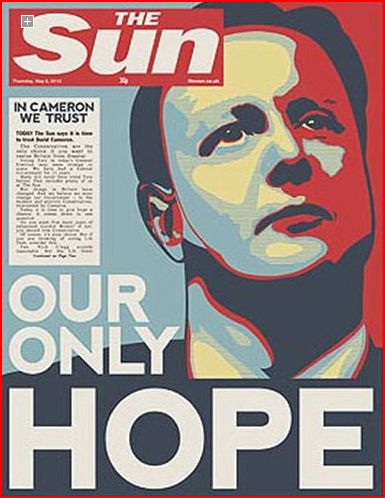
One image that stands in my mind was in 1992 – which had been a close campaign, and the result of which was still uncertain to the end. I went to the supermarket on election day and saw all the front pages lined up next to each other. Almost unanimously, they had pictures of John Major and the word ‘trust’ – the exception being The Sun with its famous front cover of Neil Kinnock in a light bulb asking that if Kinnock wins, can the last person to leave Britain please turn out the lights. The Sun later argued, perhaps with good justification, that the media’s support was the clincher for John Major's subsequent victory.


The most powerful man in British politics over the last thirty years has been Rupert Murdoch. It was no surprise that first Tony Blair and then David Cameron sought to court him. The subsequent switchings of the Murdoch allegiance are clearly seen as major events in recent British political history. Even today, the news of Nigel Farage having dinner with the Murdochs was enough to raise eyebrows.

Should this be so? Should it be the case that one person should have so much power over British politics?

The Leveson enquiry concentrated on press ethics, as was its brief, but I would like to see a future enquiry broaden out to concentrate on the overwhelming political bias in one direction of our major newspapers.

Obviously the rights of a free press should be foremost but maybe there is a case for implementing the same sort of restrictions that TV has to adhere by – that in the final weeks of an election campaign, national newspapers must show impartiality and equality of coverage to all concerned.

I am not sure how we can work on the details. And after Leveson, media relations are understandably touchy at present. But hopefully one day we can restore a balance of opinions and allow people to make their own decisions based on a wide range of advice and information. And that the election is not about which paper it was wot won it.

Friday, March 1, 2013

Channel Four News - the response to my complaint

Dear Mr Nevols,

Thank you for contacting Channel 4 Viewer Enquiries regarding CHANNEL 4 NEWS.

We are sorry to hear that you feel the timing of this report was ill-timed, we have passed your concerns onto our news editors. Please be assured your complaint has been logged and noted for the information of those responsible for our programming.

Thank you again for taking the time to contact us. We appreciate all feedback from our viewers; complimentary or otherwise.

Regards,
Steve Reynolds
Channel 4 Viewer Enquiries

A rather bland and standard response – I doubt my comments will have been ‘noted’ by anyone. However I won’t of course be taking the complaint any further.

Ironically, if it had been the intention of Channel 4 News to help the Conservative campaign in Eastleigh, it spectacularly backfired – the consequences fuelled the ‘anti-politician’ voters into the arms of UKIP and pushed the Tories into third place.

In my comments to various articles on the Conservative Home forum, I had speculated that the media would have a story on hold which will be carefully released at the right time to wrongfoot the Liberal Democrats. This proved to be the case. I felt it was disappointing that we had been so ill-prepared for this – if I could see it coming, why did no-one else? The lesson is that we need to brush up our technique for responding to such media explosions.

Fortunately, despite this and the usual barrage from the right wing newspapers, our party’s resilience and hard working held on for a great victory. I am proud to have played my own very small part in this (two days down there) and the fact that the entire party rallied around at its moment of need.

Congratulations to Mike Thornton and everyone in the Eastleigh Liberal Democrats.

Monday, February 25, 2013

Channel Four News - My Complaint

Dear Sir/Ma'am. I wish to make a complaint about Channel 4 News.

On Thursday 21 February, Channel 4 News ran a special report into alleged sexual harassment by Lord Rennard of the Liberal Democrats. I have no issue with the report itself and agree it is a newsworthy item which should be reported. My complaint is regarding the timing of the piece.

Channel 4 News are presumably aware that (i) there is a parliamentary by-election to be held at Eastleigh on Thursday 28 February, (ii) that polls indicate a close fight between the Liberal Democrats and the Conservative party, and (iii) political commentators agree on the importance of this by-election with likely consequences for either or both of the coalition parties, or even the government. It has been called the most significant by-election in 50 years.

Despite this, Channel 4 News decide to run this report at the time of maximum effect – exactly one week before polling – so that it can snowball and disable the Liberal Democrats in the lead up to polling day. One week earlier or one week later would have been different. But now, three days before the vote, the Liberal Democrats campaign in Eastleigh has been run off the tracks and Channel 4 News are the toast of every Conservative party gathering.

Surely this possibility had occurred to someone in the Channel 4 newsroom – or did they genuinely not know about Eastleigh?

The impression given is that Channel 4 News are deliberately seeking to influence the result of the Eastleigh by-election, and that the victims of the alleged abuse are being used for party political and election purposes. Such conduct is against all codes of professional ethics for televised media and removes any pretence of political impartiality by Channel 4 News.

Channel 4 News have built an enviable reputation for the quality of its news reports, so it is a shame that it should blatantly use a legitimate story in this way.

I would welcome your comments.

Sunday, December 23, 2012

Review of 2012

This is my last entry of 2012 so I am using it to review the year gone by.

The highlight of the year was the London Olympics. I took two weeks off to follow TV coverage, visited various events on five occasions, and thoroughly enjoyed it all.

The highlight of my five visits was taking my wife to Wembley Stadium to her first ever football match, where we saw Team GB Ladies defeat Brazil 1-0 in a great atmosphere. We also met some Brazilian supporters at a volleyball event in Earls Court and the colour and enthusiasm they showed on both occasions convinces me that the next Olympics in Rio 2016 should also be a success.

The low point of the year was the death of my best friend, Adam, in October after a long battle with liver disease at the age of 42. We had been good friends since meeting at university in 1988 and even now it is hard to comprehend that someone younger than me has gone so soon. As someone told me, remember the smiles. And with that spirit, I think back to the good times and to many Christmas and New Year events which we enjoyed together with other friends over the years.

Politically, it was not a great year for me but then chances were limited. There were no local elections in my area, although we had a council by-election in March which got me back into the campaigning spirit. I aimed to be an MEP candidate for the Liberal Democrats in London and, while enjoying the six week campaign, was disappointed to fall short of the final list.

Blog-wise, my most read entry was back in January with ‘Be loud and be proud. The Liberal Democrats are the party of the poor’ which, having thought about it, makes a rather misleading headline – it should mean that the Lib Dems are the best representatives of the poor, and not the fact that the party is very poor itself – although that is not too far from the truth.

I argued that by taking a million people out of paying tax completely, cutting taxes for every basic rate payer, bringing in the pupil premium to invest billions in under-performing schools, and restoring the pensions to earnings link – all of which are measures that would not have happened under a ‘pure’ Conservative government nor a Labour administration – that it is to the Liberal Democrats that the poor can look to for support. To add to this, we can point to the fact that we are vetoing over-the-top Conservative measures to cut the benefits bill. The bill needs to be cut but fairness should be the watchword. I hope we can do more to get this message across.

My favourite entry was in July when I talked about the ‘war of two coalitions’. In my view, it is a fact that the Conservative and Labour parties have an unofficial unwritten alliance to ensure they keep all the power between them, and that other parties (of whom are growing support all the time) should be kept in their place. This is chiefly why both parties are so angry with the Liberal Democrats rather than each other for daring to get into government.

This point is further strengthened by the year’s biggest political disappointment – the failure of the House of Lords reforms. Labour decided to betray their great forefathers and ally themselves with the right wing Tories in order to protect privilege and patronage in the Lords against democracy – a once in a century opportunity – which just displays the emptiness and vanity of the modern Labour party. Who would ever have thought that the Conservative party leadership would be more reformist than that of the Labour party?

As for the Liberal Democrats, I am pleased to see us pursuing our policies on tax, education and the environment. I am concerned that our ‘differentiation’ strategy has started too early – we are only halfway through the parliament and I would much prefer both parties getting on with the job. We don’t need to lower ourselves to the yah-boo spoilt-child level of Peter Bone, Nadine and the others on the Tory backbenches.

If the Conservatives can exert some discipline and keep their loony element quiet then it is quite possible the two parties can work together up to and through the next election to sort out the economy, bring in social and political changes, and keep Labour out. This, however, would be up to David Cameron. If he continues to show weakness and fails to exert discipline, it may not be long before Ed and Ed are in Numbers 10 and 11 – and then we are all in trouble!

Come 2014 we can think more about differentiation. But I want to see more co-operation and productivity in 2013. If we are worried about the council elections, we should remember that Labour did very badly in 2009 – so we will take a hit and Labour have a good result regardless.

My last act of the year in my blog is to thank you all for reading, whatever your views and whichever party you support. Without the Olympics or the Diamond Jubilee, 2013 will undoubtedly be a quieter year but I am sure we will all have just as much to talk about.

I hope you all have a very Merry Christmas and a very Happy New Year.

Saturday, December 15, 2012

Who will save the Church from itself?

One of our most treasured institutions in English life is the church, and, in particular, the Church Of England. Religion and faith is deeply rooted within our national conscience. Go to any English village or town and you will see, in pride of place, a church – sometimes it dominates the area, other times of more modest size, but in nearly every case it will be a main centrepiece of the community, an organiser of social activities, a place of celebration at Christmas, a place of solemn reflection on Remembrance Day, and always a place of worship and thanksgiving.

I write as a regular attendee at my local church. I am actively involved in event organisation and fund raising, I sit on the Church Council, and I edit the church newsletter. On Sundays, when I can, I go along to pray for my friends and family, enjoy some fine hymns, and partake in the service.

So it grieves me when I see the church and its leadership regularly shoot themselves in the foot, completely unaware of how their actions, or inactions, may make a difference to the future of the existence of the church itself.

Everyone who loves the church should bear in mind two simple facts and commit them to memory. These facts are (i) each year, the numbers regularly attending church have been steadily reducing – congregations get fewer and fewer in size, and (ii) the average age of those who regularly attend church has been increasing. Even at the age of 45, I am one of the youngest in my congregation. Apart from the children, who may have been dragged along, the vast majority of those present are pensioners – and there are very few young adults.

Should these two trends continue then, sooner than we think, congregations will die out and disappear altogether. And churches all over England will become empty disused buildings.

Why is this the case? Why don’t people go to their local church? Some tell me they are simply too busy, others that they like a lie-in on Sunday mornings after a busy working week, and others, not unreasonably, think churches are full of old people and they would feel out of place. But the most common reasons are that people say they ‘don’t feel religious’, although these people celebrate Christmas and see their kids in nativity plays or, the issue I wish to deal with, they simply do not see the relevance of the church to themselves and to today’s world. It is part of the old corrupt British establishment of politicians, financiers, businessmen, people who are only in it for what they can get out of it, and of complete disinterest to ordinary working people

Now I defend the institution as much as I can but feel the Church is its own worst enemy and this viewpoint is only confirmed by two massive blunders in recent months. Blunders which continue the battle between church and society (and history has shown that when the church battles with society, it is usually society that wins out).

The first blunder refers to female Bishops. There is still some way to go but, in the modern age, women have made great advances in all areas of society and that is something we should welcome. You would have thought the General Synod would almost unanimously have voted to allow women to be ordained as bishops – after all, why not?

The Synod did indeed vote for this measure by a considerable majority, but in the House of Laity it fell a few votes short of the necessary two thirds requirement. But people at large are not interested in the finer details and procedures of church decisions – all they know is that the church has considered the issue of women bishops and held out its hand with a big NO!

The second blunder, in my view, refers to the, perhaps more divisive issue, of same sex marriage. In the week that we learn that fewer couples are getting married than ever before, the church considers the government's proposition of same sex marriage and once again it is the hand with the NO! To be fair, some would consider allowing same sex marriages in their church, but the government decided on a complete ban on the Church of England while those of other faiths and religions have the option of ‘opt-ing in’ – a clear case of religious discrimination. Had the church shown a more positive and enthusiastic response, then the situation may be different.

In my view, the institution of marriage is a wonderful presence. I have been happily married for ten years. If two people wish to publicly commit themselves to love and protect each other, under the eyes of God and regardless of their gender, that is something we should welcome and encourage. Opponents say that marriage should be solely between a man and a woman, and I have sympathy for that view, but in the modern age, many couples are of the same sex.

Statistics show that married couples live happier, healthier and longer lives. If more people were married, the world would be a happier place. I believe that the institution of marriage would be protected not undermined by same sex marriage. As more heterosexual couples see the happiness that marriage can bring, they may well take the plunge themselves. Allowing and blessing more unions would reverse the current trend towards marriage dying out.

So what do people see of the church? They see the Archbishop of Canterbury and an array of old men dressed splendidly in fine robes, preaching to us about charity and sacrifice but not showing signs themselves of either, of an old boys club living in a long forgotten world where women know their place and the presence of homosexuality is not acknowledged.

Now, like most people, I am no religious expert. I am in no doubt there are many who would defend the Church’s view with quotes and passages from the Bible and the study of theology. I respond by borrowing the phrase of the Occupy London movement – what would Jesus do?

If he were around today, would Jesus prevent the full inclusion and participation of women in his church? Would Jesus close the door to gay people who wanted his blessing in their unions? Of course not – Jesus, and God, loves everyone. It is the Church of England who apparently does not.

We are deep into the 21st century, and as we go further on, and as society continues to change, however much many may not like it, the Church of England is crying out for the modern and forward thinking leadership that is necessary to make it relevant once again to people’s lives and the modern world. Will we see that leadership come to the forefront soon? Will the Church find the backbone within to save itself from extinction? Will anyone save the Church from itself? We can only watch, hope and, yes, continue to pray.

Tuesday, December 4, 2012

My MEP Campaign Part Five - Over ... and Out!

It was a cold morning on Saturday the first of December as I made my way to the Liberal Democrats headquarters in Great George Street, London. Today was the count to establish all the MEP candidates for England – London were to choose eight of which I hoped to be one. I had enjoyed the campaign over the last six weeks and meeting London’s Liberal Democrats, but now it was over and time to see how the London members had voted. There was a distinct ‘exam results’ feeling – with that mixture of helplessness and apprehension that all former students are familiar with.

The count for all of England’s regions was to take place that day but fortunately London were first on. Most of my fellow candidates were there and, with those from other regions waiting, we all hovered in the kitchen and corridor. Topics for discussion included the recent Croydon North by-election, the Thames Christmas cruise, and the Middle East (The EU-Israeli agreement being the most common subject of my email in-box).

A slight delay in the announcement occurred due to a computer problem, which meant the candidates for the next count started arriving and the area got very crowded. It reminded me of the old joke about Liberal MPs in a taxi when I started thinking how many Liberal Democrat European candidates can you squeeze into a corridor?

Finally, the call went out for the London candidates, we entered the presentation room and sat along the long table like they do in The Apprentice. Who will be fired?

We were treated to a whole series of charts but it was the first list that decided it. The eight candidates were listed in front of us – and my name was not there. As the programme worked through the spreadsheets to explain how the eight were put into order, my heart continued to sink.

We Liberal Democrats are used to disappointment, and I get my fair share (as any regular reader of this blog can testify), but it is still not easy. I’ve worked in London since 1994 and know the city very well. However, I was aware from the start that I was not too well known, lacked a local party base, and hence the odds were against me. Of course I was not expecting to come near the top – but was hoping to get on the list as a marker to campaign towards and promote myself. Sadly, back to square one.

This was my first campaign of this type carried out over six weeks, I did enjoy it, and I’ve learnt quite a bit to take away. If I am still in London next time round, I intend to have another bash – and by 2017-2018 who knows what the political climate will be like?

The main consolation was meeting the eight people on the London list – a highly impressive group of people with a formidable list of achievements and experience. Despite being rivals, everyone was courteous and friendly and the campaign was held in a great spirit. The air of positivity and cheerfulness as we discussed European issues, as well as the various email exchanges and discussions with the members that I met, made a great comparison to the gloom and doom we get so much of from the Tories and UKIP.

I am glad we have such a strong Liberal Democrat team to present to Londoners and I hope they do well.

Tuesday, November 20, 2012

My MEP Campaign Part Four - Some Sleepwalk, Others Tour

This week I had the novel experience of agreeing with Ed Miliband. This event does not happen very often but while reading his interview in the Sunday Telegraph and his speech to the CBI, I found myself nodding several times (instead of nodding off – my usual reaction to his speeches). He put it very well, referring to sleepwalking towards the EU exit and about the danger of Britain becoming a nation of low wages, low skills, ‘an off-shore low value economy’. I am sure these words were music to CBI ears.

There was no mention of an in-out referendum, of course, but it now seems that the Eurosceptics in the Conservative party are losing interest in that. There have been articles in the media, on Conservative Home, and a speech yesterday by David Davis, with all sorts of ingenious suggestions on carefully worded referendums (referring to renegotiation and repatriation etc) with the intention of luring the British people by stealth into voting to leave the EU without their realising it. Such shameless tactics do not explain why the Tory Eurosceptics are so terrified of asking a simple in-out question when they are convinced the people are on their side.

Another novel experience is feeling sorry for David Cameron as he heads into tough talks with the EU leaders on the budget while his own army are pointing their guns at his back. But seriously, it is getting to the stage where the Conservative party as a unit are becoming a major threat to Britain’s national security and well-being.

With Euro issues on the front pages again, my campaign has continued across London. I attended the AGM of the Beckenham Liberal Democrats where there was an impressive presentation by Merlene Emerson, the Chair of the Chinese Liberal Democrats, on an all-party visit to China and Tibet. I have attended a quiz night in Sutton which had a high turnout and good fish and chips. And I went to the AGM of Hammersmith and Fulham Lib Dems where we were addressed by Norman Baker MP, our Transport Minister, on fighting the Tories and he answered questions on general transport issues.

At all these events, I discussed European issues with many of the members to hear their thoughts and views. And the comments and questions by email have kept coming.

What is interesting is that, even in Lib Dem circles, much about Europe is misunderstood. More than one person has asked me about Abu Qatada – which of course is a reference to the European Court of Human Rights, a separate body to the European Union.

There is also far less enthusiasm for the EU than the media would have us believe amongst Lib Dems. Although there is general agreement that we should retain our membership, there was much disquiet about the budget, the amount we pay to the EU, and the level of immigration caused by open borders. However, there was also concern about the dangers of David Cameron leading us into the slow lane and, to repeat Ed Miliband’s point, that the PM is thinking more about the concerns of a few dozen MPs rather than pursuing the country’s interests.

My fellow Euro candidates have also been busy – we are frequently bumping into each other in our tours around the capital. Just over a week to go before voting closes. I have an inkling of how the result is shaping but will just say for now that the turnout will be bigger than that of the Police Commissioner elections! The campaign continues!